| Remembering our Little Daihatsu Extol Van |
|
About Hoofbag origins: As a child, the Hoofbag spent most of Its time isolated in Its bedroom. Hoofbag's father hated the Hoofbag, the Hoofbag was scared of him. When the Hoofbag became adult It had inclination to mix with people, a ‘People Person’. Living in London, this drove Hoofbag to partake on tenant consultation groups. Upon moving to St Leonards, East Sussex, The Hoofbag volunteered on the Hastings Community Housing committee. In social housing the Hoofbag got acquainted with people having compromised health. Clearly, some tenants deserved higher rewards of DWP benefits. A blind lady and husband/carer, deserved higher DWP rewards. The Hoofbag got them DLA. Also, a learning disabled man was wrongly deemed capable of independent living. 3 years later, he died. RIP Simon, you were a gr8 guy! The Hoofbag's partner John died in 2011. Unbeknown to the Hoofbag, he had left his chalet to It, where Hoofbag now lives. |
|
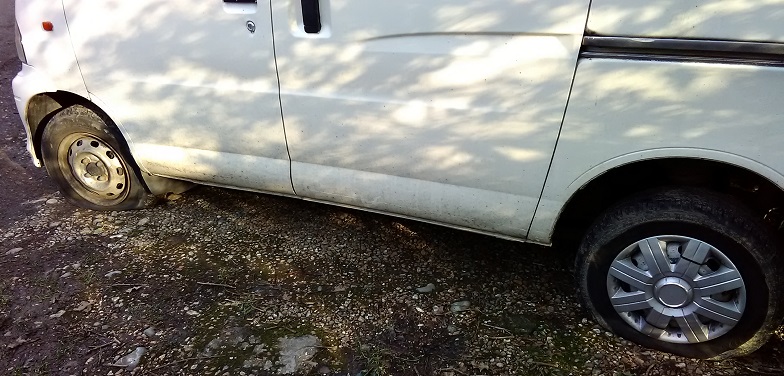
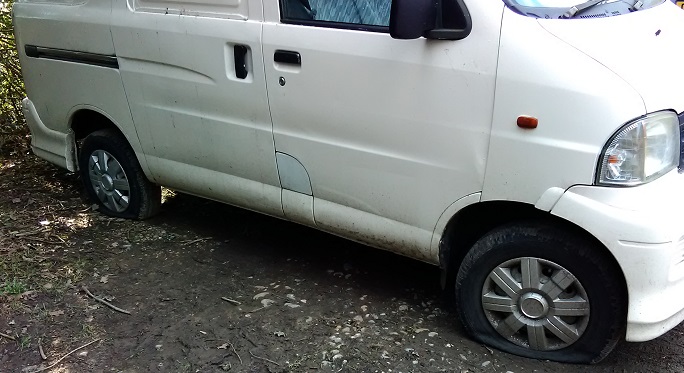
On the 21st February 18, 15.00, the Hoofbag went to our micro van only to discover that all four tyres had been slashed. We very much struggle financially, the van belong to my partner. |
|
|
So important in our lives are our vehicles, being the second major purchase after our homes. Gemma bought our little Daihatsu Extol Van out of her redundancy pay. Our idea was to do little jobs here and there, such as moving sofas and fridges, but also building materials to improve our home. We’re desperately poor. If I need to do any alterations or improvements, we can generally do these things for ourselves. Contemplating an immediate future of extreme poverty, we felt confident that the resourceful two of us, equipped with our little van, would be an efficient little unit capable of, not only helping ourselves but others as well, as we’ve always done. I get a small amount of widows’ pension that I use to buy food and other things and at the moment I’m supporting my partner out of my income because she has no effective income. If we’d been allowed to keep our little van, we might have had the possibility of increasing our income so we can keep ourselves warm and fed in the harsh winter. |
|
|
|
From when I originally drove a micro van, I thought of them as my favourite run about vehicle. The first one I had was a Honda Activan. With only a 650CC engine, I was astonished how fast this thing went: for a tiny engine like this, I managed to get 70mph out of the thing and it really did have more to offer. I didn’t want to break the speed limit, though. Honda really do make excellent small engines with so much power for their size and is how this Japanese company built their world renowned reputation with all their vehicles. Sadly, the van had to be scrapped when a car collided with the back of our little Honda. Like many of these micro-vans, the engine is mounted low down in the chassis to give a good centre of gravity. A collision may cause the chassis to skew and the engine will never come out, however hard the mechanic tries, in the event of maintenance. Most of the top engine parts in these vans are accessible through a removable panel in the floor, such as spark plugs and timing adjustments. |
| The Daihatsu engine is under the seats and is 1.3L. It can manage 70mph but the engine is reving really high at this speed, so I felt safer going at a lower speed: 60MPH max. This van certainly isn't a motorway mucher! 60 would be my maximum suggested speed for comfort. The van handles really well, especially when cornering and the relatively high driving angle makes it a lot easier at night to see the road and hazzards, good for us over 60s lot. I’m friends with one or two local bands and musicians. I’ve always wanted to be in a band but suffering ME/CFS means that I’m not able. However, I loved feeling part of the Hastings music scene through my contribution of being able to move amplifiers, speaker cabinets and large keyboard units. I can rarely lift these things myself but the guys would do the lifting as long as I could drive and provide the van. Mindless thugs are cable of nothing at all but claiming DWP benefits and popping out sprogs, using their fecundity to hold the state to ransom. Most would be incapable of hanging a shelf, fitting a plug on the end of a power lead or a full house rewiring, something the Hoofbag and partner would undertake with ease. The Hoofbag is a qualified electrician and electronics engineer. |
|
|
|
When some mindless, useless thug sets out to slash your tyres, most would just arrange a repair with a garage mechanic who’d send out a low loader and the vehicle will be picked up and driven away, only to be returned problem sorted, sometime later. The garage would probably arrange to have a courtesy car so that the family’s day to day routine isn’t disrupted. An issue here is, if we tried to get the insurance company to help, it would result in an increased premium at the time of insurance policy renewal. Whatever solution to our Daihatsu Extol van repair issue is pursued, huge expense was entailed. A low loader has to be sent out and that alone costs money. Where the van has to be collected from is a severely space restricted area, incurring additional difficulties. It was an uneconomical repair. If we were to be audacious enough to start using our parking space, that we own, we run the risk of another tyre slashing on the replacement vehicle, as once the hired thugs have been here once, knowing our van’s location, more slashing will commence. One bonus for other residents is the availability of an extra parking space. Parking spaces in our vicinity are a constant cause of conflict, like anywhere else in our crowded part of the world, the UK. |
| Already, local people are taking the liberty of using our space for their cars, which will probably include the associates of the scum who slashed our tyres.Accordingly, if the vehicle is presumed to be ours, your vehicle is at risk. Be warned! Slashing tyres is a serious criminal offence but the local Hastings police force is not at all interested, we’re on our own, even though knife crime is on the increase: 14 youths were fatally stabbed in Londistan between the start of the year and May. Please note: anyone reading this might have a suspicion of the associate and who they might have employed to cause the damage to our tyres. Not necessarily linking these actions to any car owned by someone who has a vehicle provided on the UK Motability scheme, we’d strongly urge anyone to avoid retaliatory actions against any car owner in our vicinity. Really, don’t do it! The UK Motability scheme provides vehicles to ‘special snowflakes’, to use a modern colloquial. Unlike the rest of us who may suffer vandalism at the hands of these mindless thugs, the Motability scheme have at their disposal large sums of money to employ private investigators to pursue a case against anyone interfering with their vehicles. Be warned! | |
|
|
|
|
|
|
|
|
|
|
|